
A wireless remote control lets an operator stand where the platform, load and surrounding traffic are clearly visible. For a truck tail lift, the right choice depends on the required functions, receiver voltage, working environment and the tail lift’s actual wiring logic.
What Does a Tail Lift Remote Control Need to Control?
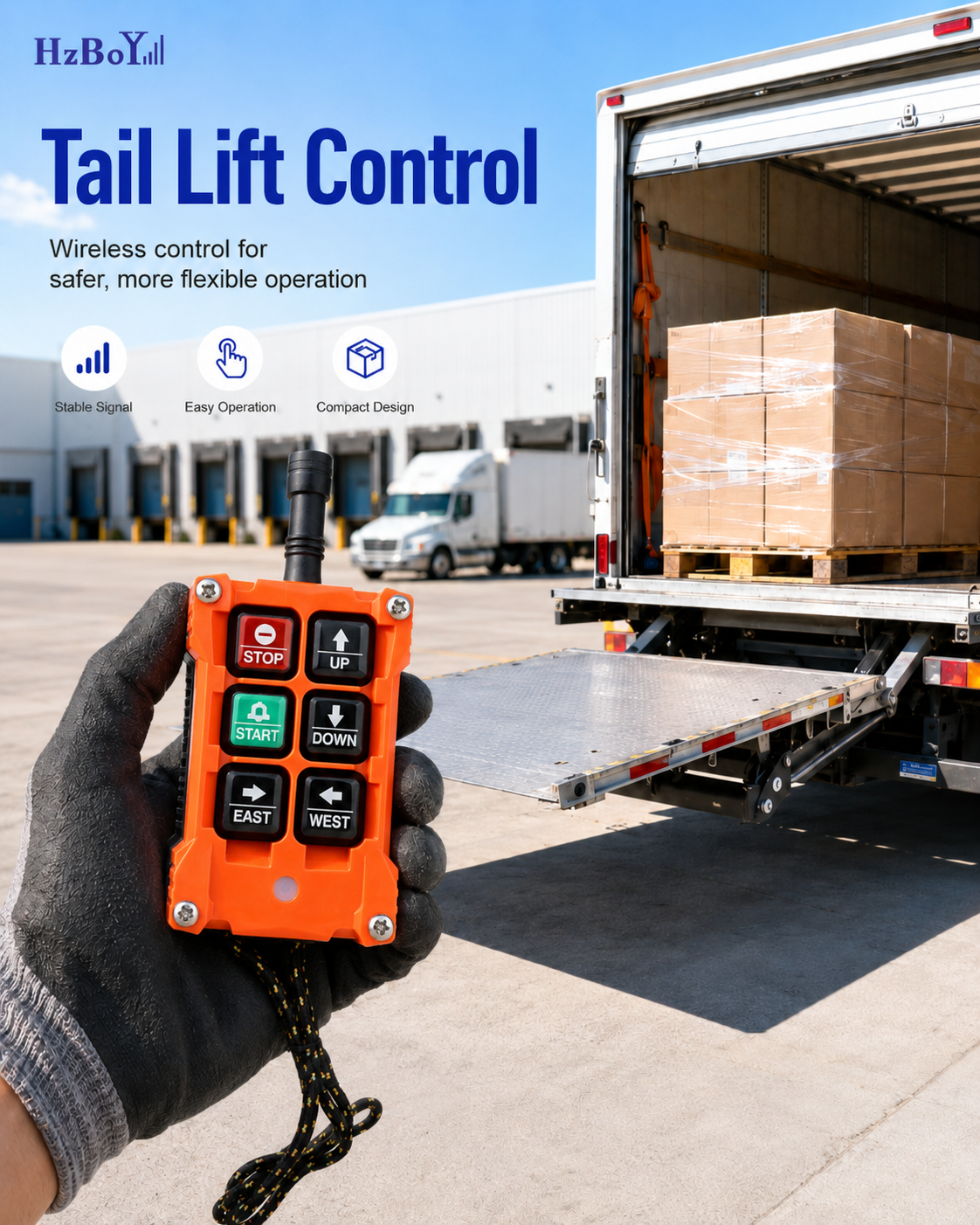
Truck tail lifts are hydraulic systems, but their control circuits are not all identical. Common commands may include Lift, Lower, Tilt Up and Tilt Down. Some designs instead use Open, Close, Fold or Unfold. A four-button transmitter is therefore useful only when its relay outputs are configured for the functions required by the specific machine.
The remote control does not replace the hydraulic power unit or the original safety circuit. It sends control signals to the receiver, and the receiver switches the corresponding equipment circuits. Before production or installation, confirm the button functions, receiver supply voltage, common-wire arrangement and the tail lift wiring diagram.
When Is a Two-Button Tail Lift Remote Enough?
A two-button remote is appropriate when the tail lift control system requires only two single-speed commands, typically Lift and Lower. It is not the right choice when the equipment also needs Tilt, Fold, Open or Close unless those functions remain on a separate control.
F21-2S: Traditional Two-Button Industrial Control
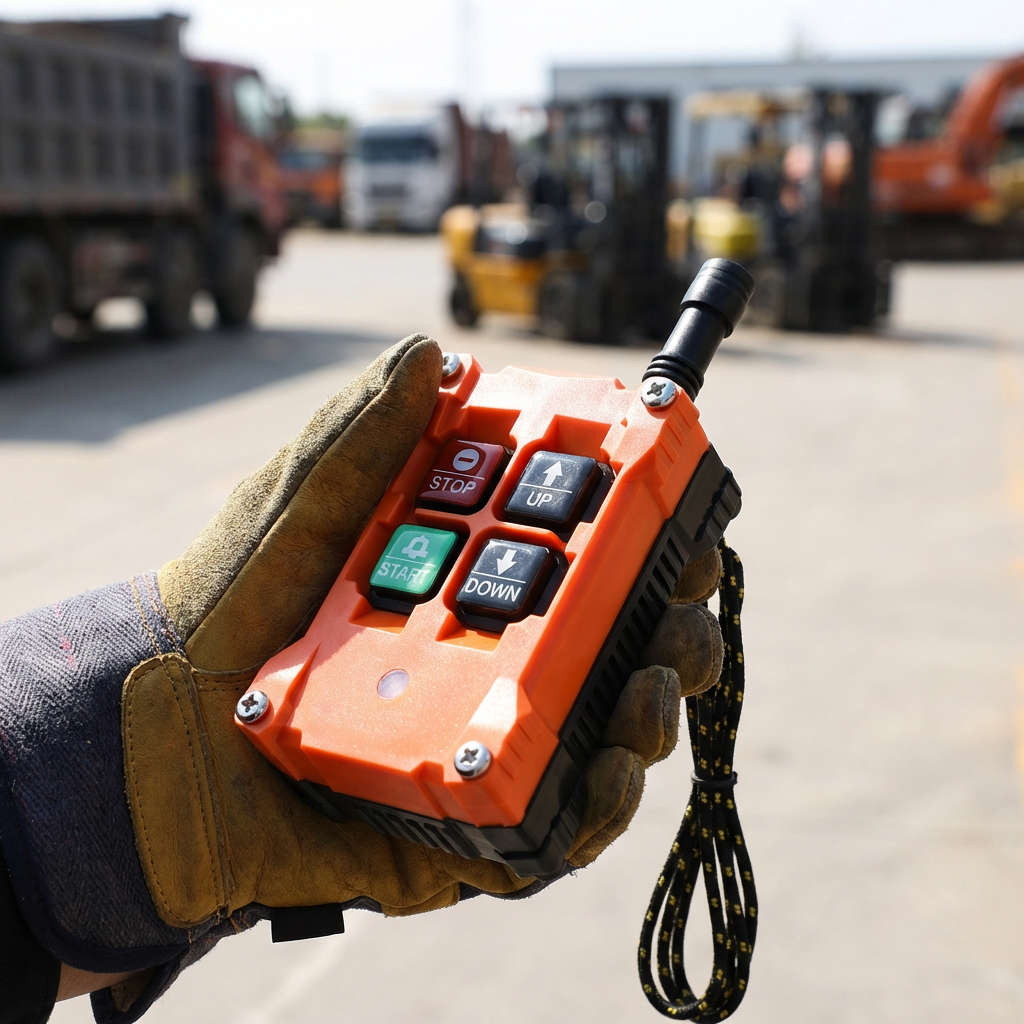
The HZBOY F21-2S provides two single-speed function buttons, IP65 protection and a standard operating distance of about 100–150 m. Receiver options include DC 12–24V or AC/DC 24–450V, depending on the selected version. Its transmitter uses two AAA alkaline batteries, making it a straightforward choice for simple UP/DOWN equipment.
M2: Compact Rechargeable Two-Button Control
The HZBOY M2 combines two function buttons with a compact rechargeable transmitter. It uses a 400 mAh battery with Type-C charging, typically supports around 40–50 hours of use, and has IP65 protection. Its working distance is approximately 50–100 m, reaching about 100–150 m in suitable open conditions. It is practical for operators who value portability and frequent movement around the vehicle.

Important: Two buttons do not automatically mean compatibility. Confirm the receiver supply voltage, required relay outputs, common-wire arrangement and the tail lift wiring logic before ordering.
M4 vs F21-4S: Which Model Fits Your Application?
| Selection Point | HZBOY M4 | HZBOY F21-4S |
|---|---|---|
| Control type | 4 single-speed buttons | 4 single-speed buttons |
| Transmitter style | Compact mini design | Traditional industrial handheld design |
| Power | 400 mAh rechargeable battery with Type-C charging | Replaceable-battery transmitter |
| Typical working distance | 50–100 m; up to about 100–150 m in open conditions | About 100–150 m under suitable conditions |
| Protection | IP65 | IP65 |
| Best suited for | Tail lifts, tow trucks, winches and compact mobile equipment | Tail lifts, hoists, trolleys and general industrial equipment |
Choose M4 for Compact, Rechargeable Control
The M4 is easy to carry and charge. Its four buttons can be assigned to the functions required by the equipment, subject to the receiver program and wiring. A full charge typically supports around 40–50 hours of use, depending on operating frequency and conditions. The compact housing is especially practical for delivery vehicles and service trucks where operators move frequently around the vehicle.
Choose F21-4S for a Traditional Industrial Format
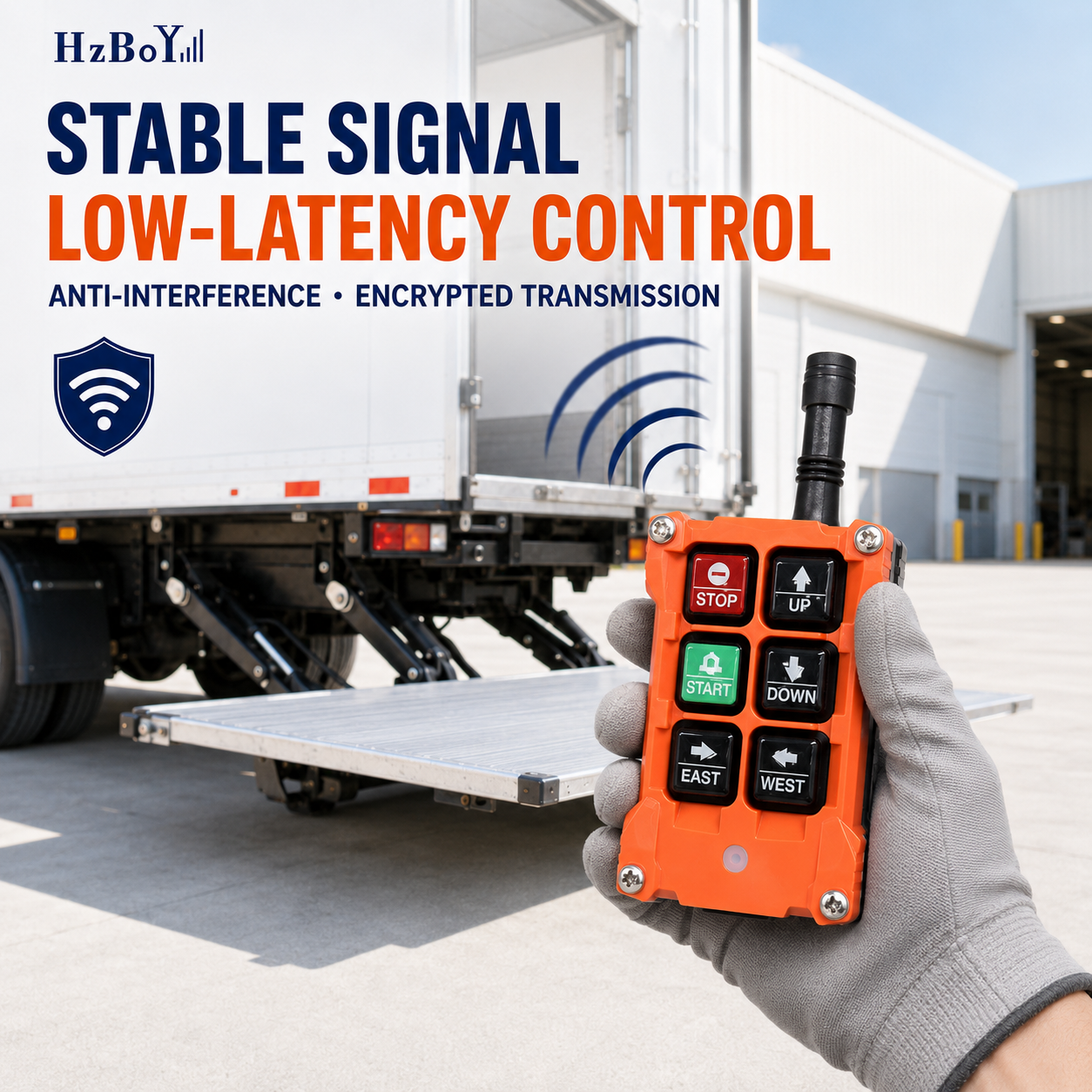
The F21-4S uses four single-speed buttons in a familiar industrial transmitter layout. It is a practical option when the customer prefers replaceable batteries, a larger handheld enclosure and a standard working distance of about 100–150 metres. It is widely suited to equipment that needs four independent ON/OFF commands.
Receiver Voltage and Wiring Compatibility
Voltage selection is critical. HZBOY configurations are commonly available for DC 12–24V systems or AC/DC 24–450V applications, depending on the model and receiver version. Vehicle-mounted hydraulic equipment normally uses a DC electrical system, but the actual voltage must be checked on the machine—not assumed from the vehicle type alone.
A remote control should never be connected only by matching wire colors. Confirm the receiver power input, relay common terminals, required outputs and the original equipment safety interlocks. If a diode arrangement, motor contactor, solenoid valve or special interlock is used, the wiring solution may vary by tail lift brand and model.
- Tail lift brand, model or wiring diagram
- Receiver supply voltage
- Required button functions and operating logic
- Quantity and destination country
- Preferred frequency, label language, color or logo
OEM and ODM Support for Equipment Manufacturers
HZBOY supports equipment manufacturers, distributors and system integrators with model selection, receiver programming, button labels, housing colors, logo customization and packaging. Each configuration should be checked against the equipment before batch production. Products are tested before shipment, and wiring guidance can be prepared when complete project information is available.
For replacement orders, send the existing transmitter model and receiver label whenever possible. Similar-looking transmitters are not automatically compatible because frequency, ID, program and receiver logic may differ.
Frequently Asked Questions
Is a wireless tail lift remote universal?
No. The number of buttons may be similar, but voltage, frequency, receiver outputs and equipment wiring logic must match.
Can one remote control Lift, Lower, Tilt Up and Tilt Down?
Yes, if the tail lift supports those four commands and the receiver is programmed and wired accordingly. Other machines may use different functions.
Which is better for a truck liftgate, M4 or F21-4S?
M4 is better when compact size and rechargeable operation matter most. F21-4S is better when the buyer prefers a traditional industrial transmitter, replaceable batteries and a longer standard operating distance.
Need Help Selecting a Tail Lift Remote?
Send HZBOY your equipment model, voltage, required functions, quantity and destination. Our team will recommend a suitable configuration and provide a quotation.